
Blog
Retatrutide Before and After
Aug
Retatrutide Before and After: Understanding Your Transformation Timeline
What does retatrutide actually look like at 4 weeks, 12 weeks, 6 months and beyond? We use Phase 3 clinical trial data to build you a realistic, honest picture.Start Your Protocol → Results Timeline
Related: Full Results Timeline Dosage Guide Side Effects by Week Buy the Pen Kit
In This Article
- Before Retatrutide: What Most Users Describe
- After 4 Weeks
- After 8 Weeks
- After 12 Weeks
- After 24 Weeks
- After 48–80 Weeks
- What the Numbers Look Like at Your Starting Weight
- Beyond the Scale: What Else Changes
- FAQ
Before Retatrutide: What Most Users Describe
Understanding the “before” picture helps contextualise what the treatment is actually changing. The users who choose Synedica Retatrutide typically share a common experience before starting: persistent, intrusive hunger that conventional dieting does not reliably suppress; a preoccupation with food that competes with focus and quality of life; and in many cases, a history of weight loss followed by regain — sometimes through previous GLP-1 protocols that have now plateaued.
The metabolic state before treatment is characterised by a body actively defending a higher weight set point. Every caloric deficit triggers hunger hormones that drive eating back up. Retatrutide’s triple receptor approach directly interrupts this cycle at three separate hormonal levels simultaneously.
After 4 Weeks: The Initiation Phase
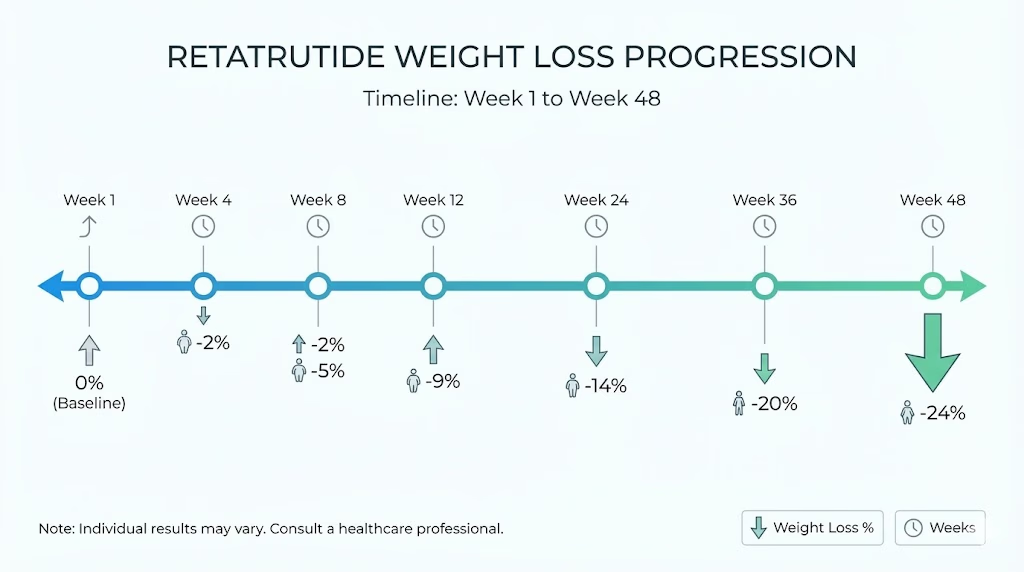
Typical weight loss: 1–2% of body weight.
The first four weeks at 2.5mg are about adaptation, not results. The scale moves slowly — 1–3 lbs for most users — but important changes are already underway. Appetite signalling is shifting. Most users report that meals feel more satisfying with smaller portions within the first 2–3 weeks. Between-meal hunger begins to reduce. Food preoccupation starts to ease.
Side effects are typically minimal at the starting dose. The most common experience is mild, brief nausea in the first 3–5 days after each injection. By week 4, most users have adapted to 2.5mg with no meaningful ongoing side effects.
⚠️ Do not judge retatrutide by week 4 results. The 2.5mg initiation dose is pharmacologically below the therapeutic range. The numbers change substantially once escalation begins. Week 4 is building the foundation for what comes next.
After 8 Weeks: The First Escalation
Typical weight loss: 3–6% of body weight cumulative.
Week 5 brings the first dose increase to 5mg — and with it, a noticeably different experience. Appetite suppression strengthens significantly. Satiety signals last hours longer after meals. Many users describe this as the point where eating to hunger naturally becomes a substantially smaller endeavour — not through willpower but through hormonal signalling genuinely changing.
Weight loss accelerates. Many users lose 1–2 lbs per week in weeks 5–8. By the end of week 8, cumulative losses of 3–6% of starting body weight are typical. Clothing fit begins to change. The side effect peak — worst around week 5–6 — has largely settled by week 8 as the body adapts to 5mg.
After 12 Weeks: Full Acceleration
Typical weight loss: 8–13% of body weight cumulative.
By week 12, most users have progressed to 7.5mg or are on their way there. Triple receptor activation is at meaningful therapeutic levels. This is typically the period of the most dramatic visible changes — facial structure, waist circumference, and the way clothes fit are all clearly different. People who have not seen you recently will notice.
Metabolic markers are improving: blood pressure, fasting glucose, and in users with elevated liver fat, early signs of hepatic fat reduction. The side effects of escalation have largely resolved at stable doses. Most users describe weeks 12–16 as the period when the treatment stops feeling like a medical intervention and starts feeling like simply being a person who is not driven by constant hunger.
After 24 Weeks: The Data Landmark
Phase 2 average at 12mg: 17.5% body weight reduction.
The 24-week mark is where retatrutide’s Phase 2 trial published its interim results — and the numbers were the first signal that the triple agonist would outperform everything before it. At 17.5% average weight loss in 6 months, users are typically experiencing transformation that is visible to everyone around them. For a person starting at 250 lbs, that is approximately 43 lbs lost.
At this stage, most users have reached their maintenance dose. Side effects are minimal to none for the majority. Energy levels, which may have dipped during active escalation, have typically stabilised. The glucagon-mediated energy expenditure increase is contributing to continued fat loss even during periods of dietary stability.
After 48–80 Weeks: The Full Picture
24.2%
Phase 2 average at 48 weeks, 12mg dose
25–28.3%
Phase 3 TRIUMPH-1 average at 80 weeks
45.3%
Participants achieving ≥30% weight loss (TRIUMPH-1)
No plateau
Weight loss trajectory still declining at 80 weeks in all trial arms
One of retatrutide’s most clinically significant characteristics is the absence of a weight loss plateau in trial data through 80 weeks. The rate of loss slows as a new energy equilibrium is approached, but it does not stop. This distinguishes retatrutide from earlier GLP-1 agents that typically plateau by 52–72 weeks. (Source: Lilly, May 2026)
What the Numbers Look Like at Your Starting Weight
| Starting Weight | After 12 Weeks (~10%) | After 24 Weeks (~17.5%) | After 80 Weeks (~25%) |
|---|---|---|---|
| 180 lbs (82 kg) | −18 lbs | −31 lbs | −45 lbs |
| 220 lbs (100 kg) | −22 lbs | −38 lbs | −55 lbs |
| 260 lbs (118 kg) | −26 lbs | −45 lbs | −65 lbs |
| 300 lbs (136 kg) | −30 lbs | −52 lbs | −75 lbs |
| 350 lbs (159 kg) | −35 lbs | −61 lbs | −87 lbs |
These figures represent Phase 3 trial averages. Individual results will vary based on dose reached, adherence, diet, exercise, and metabolic profile. Some users exceed these averages; others fall below. What matters clinically is the trajectory — consistent, sustained loss without the plateau that has historically undermined long-term outcomes.
Beyond the Scale: What Else Changes
The before-and-after picture of retatrutide extends well beyond weight. Phase 3 trial data documents meaningful improvements across multiple health markers:
- Liver fat: 86% of Phase 2a participants achieved normal liver fat levels at 24 weeks at the 12mg dose
- Joint pain: TRIUMPH-4 showed clinically significant reductions in knee osteoarthritis pain scores alongside weight loss
- Blood glucose: TRANSCEND-T2D-1 showed A1C reductions of up to 2.0 percentage points in type 2 diabetes patients
- Blood pressure: Consistent improvement reported across all Phase 3 trial arms
- Sleep apnoea: Under investigation in dedicated TRIUMPH sub-studies — early data suggests significant improvement with weight loss of 20%+
- Food relationship: The majority of users report that the relationship with food changes fundamentally — eating becomes a background activity rather than a foreground preoccupation
Frequently Asked Questions
How quickly will I see retatrutide results?
Appetite changes begin within 2–3 weeks. Visible scale movement typically begins weeks 4–8. The fastest rate of loss occurs during the escalation phase — months 2–5 — when doses are actively increasing and triple receptor activation is building toward therapeutic levels.
Will I regain the weight if I stop retatrutide?
Phase 2 follow-up data showed weight regain beginning within 2–3 weeks of stopping, consistent with all GLP-1 medications. This reflects the ongoing nature of obesity as a chronic condition — the body’s set point and hunger mechanisms return when the drug clears. Like other metabolic treatments, retatrutide typically requires continued use for sustained results.
Is 10% weight loss on retatrutide considered a good result?
Yes. Even 10% weight loss is associated with clinically significant improvements in blood pressure, blood sugar, cholesterol, joint pain, and cardiovascular risk — all well-established in metabolic medicine. The trial averages of 25–28% represent the mean across a diverse population, not the minimum required for meaningful health benefit.
Begin Your Transformation
The Synedica Retatrutide 40mg Pen Kit — the protocol that delivers these results. Free shipping on all orders.
Order the Pen Kit →View Dosage Guide
Sources & References
- Eli Lilly. TRIUMPH-1. May 2026. prnewswire.com
- Eli Lilly. TRIUMPH-4. December 2025. investor.lilly.com
- Jastreboff et al. Retatrutide Phase 2. NEJM, 2023.
- Nature Medicine. Retatrutide MASLD sub-study. 2024. nature.com
